
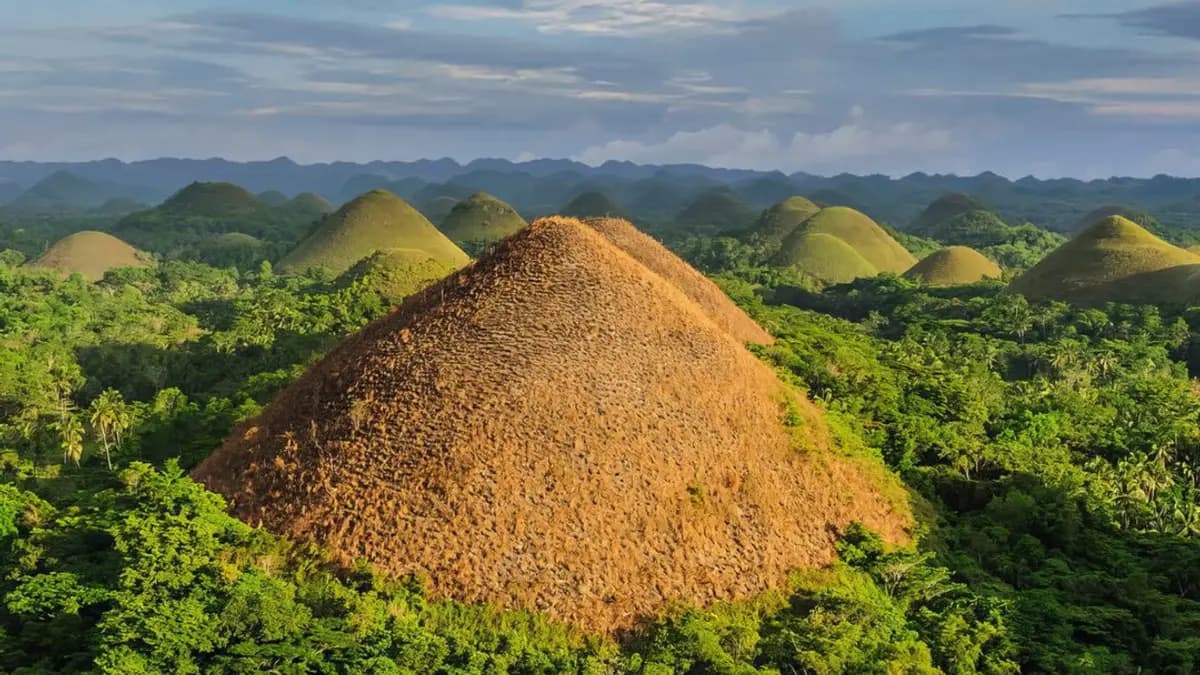
The Chocolate Hills are a field of at least 1,268 nearly symmetrical grass-covered limestone hills spread across Carmen, Batuan, and Sagbayan in central Bohol, Philippines. They rise between 30 and 120 metres above the surrounding flat land. During the dry season, from roughly January to May, their green grass turns brown, giving the hills the chocolate-coloured appearance that named them. They are the most recognised natural landmark in Bohol and are listed as a National Geological Monument of the Philippines.
How many Chocolate Hills are there in Bohol?
The official count recognised by the Philippine government is at least 1,268 hills, though some surveys put the figure higher. Estimates range up to 1,776 depending on the boundaries used and how minor formations are counted. The hills are scattered across roughly 50 square kilometres in the municipalities of Carmen, Batuan, and Sagbayan. The main viewing complex sits in Carmen, about 55 kilometres from Tagbilaran City, and its observation deck gives you a 360-degree view across the densest cluster of formations.
The sheer number is part of what makes the site unusual. A single cone-shaped hill would be a geological curiosity. More than a thousand identical ones, covering three towns, is something else entirely.
What is special about the Chocolate Hills?
What sets the Chocolate Hills apart from other karst landscapes is their unusual uniformity. Most limestone karst terrain is jagged and irregular. These hills are smooth, dome-shaped, and strikingly similar in form, which is why they have attracted scientific attention.
Geologists describe them as a karst formation produced by the weathering of marine limestone over millions of years. The process worked like this:
- Ancient coral reefs were pushed above sea level by tectonic activity.
- Rainwater, which is mildly acidic, dissolved the limestone along fracture lines over millions of years.
- The harder limestone cores were left standing while softer surrounding material eroded away.
- The resulting cones were then covered by a thin layer of grass, which turns brown in the dry season.
The uniformity of the hills is still not fully explained. The leading theory points to consistent fracture patterns in the original limestone bed, which caused erosion to proceed at similar rates across the entire area.
What is the legend behind the Chocolate Hills?
Two local legends compete for the most popular explanation. The better-known one involves two giants, Arogo and Dolutan, who hurled boulders and sand at each other in a prolonged battle. When they finally made peace and left, they forgot to clean up. The piles of debris they left behind became the hills.
The second legend is more melancholy. A giant named Arogo fell in love with an ordinary mortal woman named Aloya. When she died, his tears dried on the landscape and became the hills, which is why they look brown: he never stopped grieving.
Neither is meant as literal history, but both are told widely by local guides and have become part of how Boholanos introduce the site to visitors. The legends are a good conversation starter on the drive up from Carmen town proper.
Is the Chocolate Hills part of the 7 Wonders of the World?
No. The Chocolate Hills are not on any official 7 Wonders list. The distinction that does carry official weight: the Philippine government declared them a National Geological Monument in 1988, and the Philippines put them on the UNESCO World Heritage tentative list in 2006. They are on that list but have not been formally inscribed.
What wildlife lives around the Chocolate Hills?
The Chocolate Hills complex is one of the few places in the world where you can see the Philippine tarsier (Carlito syrichta) in a semi-wild setting. The tarsier is one of the world's smallest primates, nocturnal, and endemic to a handful of Philippine islands including Bohol. Several sanctuaries near the hills offer a closer look, with the Tarsier Research and Development Center in Corella being the most reputable.
Beyond tarsiers, the grassland and forest patches around the hills support:
- Various endemic Philippine bird species, including the Philippine eagle-owl
- Flying foxes (large fruit bats) that roost in nearby forest areas
- Monitor lizards and several snake species
- Butterflies and insects adapted to the limestone grassland habitat
The Chocolate Hills themselves are mostly open grassland at the tops, so the richer biodiversity is in the forest corridors between formations and in the river areas below.
What can you do at the Chocolate Hills Complex?
The main Chocolate Hills Complex in Carmen is managed by the local government and charges an entrance fee. The fee was revised in 2025 and the amount has been disputed locally, so confirm the current rate with the Carmen tourism office or your tour operator before you go.
On-site and nearby activities include:
- Observation deck viewing: Two viewing decks at the top of a staircase (214 steps) give panoramic views of the hills. The best light for photography is early morning.
- ATV rides: Operators around Carmen offer all-terrain vehicle rides through the hills. Ask about route length when you book.
- Sagbayan Peak: A viewpoint in Sagbayan with a different vantage point over the hills, and fewer crowds than the main complex.
- Chocolate Hills Adventure Park: Located in Carmen, this park offers zip-lines, including a bike zip-line, and rope courses in the hills.
- Butterfly garden visits: A butterfly garden near Bilar is a short drive away and often paired with a Chocolate Hills trip.
- Loboc River cruise: Most organised Bohol day tours combine the hills with a floating restaurant lunch cruise along the Loboc River, roughly 30 to 40 minutes away by road.
Sunrise visits are possible if you arrange transport from Tagbilaran or Panglao the night before, and the cooler morning air makes the 214-step climb noticeably easier.
How do you get to the Chocolate Hills from Panglao?
Panglao Island is the most popular base for visitors to Bohol, and the Chocolate Hills are a standard day trip from there. The drive from Amihan Resort to the Chocolate Hills Complex is about 1 hour 40 minutes (69 kilometres on Google Maps), depending on traffic through Tagbilaran City.
Practical transport options:
- Organised day tour: Most resorts and tour operators in Panglao offer a full-day Bohol countryside tour that includes the Chocolate Hills, tarsier sanctuary, Loboc River lunch cruise, and other stops. Ask what is included before you book.
- Hired multicab or van: Renting a vehicle with a driver for the day gives you more control over timing and stops. Ask for the full-day rate and what it covers before you book.
- Public buses: Buses from Dao Terminal in Tagbilaran run to Carmen. This is the cheapest option but requires getting yourself from Panglao to Tagbilaran first, usually by tricycle.
Guests staying at Amihan Resort in Danao, Panglao, are well-placed for a countryside day trip. The resort is about 5 minutes by car from Bohol-Panglao International Airport, and round-trip airport transfers can be arranged through the resort's tour desk, which makes the arrival-to-adventure logistics straightforward.
When is the best time to visit the Chocolate Hills?
The hills are brown and visually striking from roughly January through May, when the dry season dries out the grass. If you visit between June and December, the hills are green, which is still beautiful but different from the postcard image most people associate with the site.
The dry season also means clearer skies for photography. The wet season brings lush green surroundings but can include overcast mornings and brief rain showers. Typhoon season (June through November) occasionally affects road conditions in Bohol, though the island is less typhoon-prone than northern Luzon.
The Chocolate Hills are open year-round. Weekday mornings are quietest. School holiday weekends, particularly Holy Week and the summer months of April and May, bring larger crowds to the observation deck.
Practical tips before you go
A few things worth knowing before the trip:
- Wear comfortable shoes. The 214 steps to the main deck are steep and can be slippery if wet.
- Bring water. The climb in dry-season heat is dehydrating.
- The complex has basic restrooms and a small souvenir area at the base.
- Photography drones require a permit from the Civil Aviation Authority of the Philippines (CAAP) and prior coordination with the local government unit. Flying without one is prohibited.
- There is no direct bus from Panglao to Carmen. All public transport routes go through Tagbilaran first.
Pairing the Chocolate Hills with a morning tarsier visit and an afternoon Loboc River cruise is the standard Bohol countryside loop, and it fits comfortably into a single day departing from Panglao by 7:00 or 7:30 AM.